
Voxelotor能改善微流控静脉缺氧下的唾液红细胞流动

ty10086 提交于 周三, 08/25/2021 - 16:40
文章英文标题
Voxelotor Improves Sickle Red Blood Cell Flow Under Hypoxia in a Microfluidic Venule
正文
引言\n镰状细胞疾病在全国和全球都影响着大量人口。这种疾病的特点是存在镰状血红蛋白,HbS,它使红细胞在脱氧后聚合成僵硬的镰状。这种聚合反应可引起多种并发症,尤其是血管闭塞。Voxelotor ( Oxbryta,Global blood therapys )是FDA批准的治疗镰状细胞疾病的新治疗药物,当与HbS结合后,维持氧Hb状态,抑制聚合。此前的研究已经证明了体素转运体通过微钳技术改善镰状红细胞( sRBC )的变形能力,并通过黏度计降低低氧下的黏度( Dufu et al .,2018 ),但其在动态流动条件下的效果还有待探索。微流体装置已成为研究镰状细胞疾病的有用工具,允许在生理条件下研究sRBC的流变特性。在本实验研究中,我们旨在利用微流控平台,在生理相关系统中可以直接观察镰状血流,考察体素otor对血液流变学特性的影响。\n材料与方法\n全血取自6例镰状细胞病( HbSS或HbSC )患者,作为IRB批准的常规血液工作的一部分。该队列包括儿童和成人患者,均为羟基脲的通断者。将一份体素otor在DMSO (二甲基亚砜)中的储备液混合,置于-20℃保存,直至使用。用离心法分离红细胞,用生理盐水固定红细胞压积至25 %。血样中加入Voxelotor,终浓度为500 uM。Voxelotor处理后的样品在37℃孵育1小时。还从每个患者样本中获得未经处理、不孵育的液体,供对照品使用。从两个病人样本,一个DMSO车辆对照也在37℃孵育一个小时作为额外的对照。使用电子调压器,每个处理的血液在恒压下通过微流控装置驱动,在收集RBC速度数据的同时暴露在缺氧条件下。本实验中的微流控装置设计与制作在先前发表的研究中得到描述( Wood et al .,2012 );Valdez et al,2019 )。简言之,由聚二甲基硅氧烷( PDMS )构建的3层微流控装置由血液、水化和气体层组成。整个实验过程中盐水通过水化层进行灌注,防止血液蒸发。氧气气体通过气体层,将流动的血液暴露在使用空气和氮气罐提供的混合装置实现的特定氧气张力中。一个光纤传感器在整个实验过程中记录气体层内部的氧张力。用0 ~ 21 %的氧饱和度( 0 ~ 160mmHgpO2 )进行脱氧-加氧循环。在0 %以后的每个除氧循环中,氧饱和度以逐步滴定的方式上升,直到观察到与氧无关的流动。通过高帧率成像和计算视频处理跟踪细胞在微通道内的运动来评价RBC速度。\n结果与结论\n镰状RBC暴露在脱氧条件下,速度降低,如图1中的一个样本实例示踪所示。然而,在500uM处添加体素otor改善了血液对脱氧的血流反应,因为在低氧条件下,当暴露于低至0mmgHg氧时,经体素otor处理的RBCs与车辆对照和未处理样品相比速度变化有所降低(图2 )。此外,与对照组相比,体素焦处理后的样品在较低的氧张力下开始体验与氧无关的速度。通过抑制聚合,体素otor提高了低氧条件下镰状RBC血流反应的敏感性。聚合物i .
文章内容(英文)
Introduction(#br)Sickle cell disease affects a large population both nationally and globally. The disease is characterized by the presence of sickle hemoglobin, HbS, which polymerizes the red blood cell into a stiff, sickle shape upon deoxygenation. This polymerization causes several complications, most notably, vaso-occlusion. Voxelotor (Oxbryta, Global Blood Therapeutics) is a newly FDA approved therapeutic for the treatment of sickle cell disease that, when bound to HbS, maintains the oxy-Hb state and inhibits polymerization. Previous studies have demonstrated voxelotor's ability to improve the deformability of the sickle red blood cell (sRBC) via micropippeting and reduce viscosity under hypoxia through using a viscosmeter(Dufu et al, 2018), however its effect under dynamic flow conditions has yet to be explored. Microfluidic devices have served as useful tools to study sickle cell disease, allowing investigation under physiologic conditions of the rheological properties of the sRBC. In this experimental study we aim to examine voxelotor's effect on rheological properties of blood using a microfluidic platform that allows for direct observation of sickled blood flow in a physiologic relevant system.(#br)Materials and Methods(#br)Whole blood was drawn from 6 patients with sickle cell disease (HbSS or HbSC) as a part of routine blood work under an IRB approved protocol. The cohort included both pediatric and adult patients both on and off hydroxyurea. A stock solution of voxelotor in DMSO (dimethylsulfoxide) was mixed and stored in -20C until use. Red blood cells (RBCs) were isolated using centrifugation and fixed to 25% hematocrit with saline. Voxelotor was added to the blood samples for a final concentration of 500 uM. Voxelotor treated samples were then incubated at 37C for one hour. An untreated, non-incubated aliquot from each patient sample was also obtained to serve a control. From two patient samples, a DMSO vehicle control was also incubated at 37C for one hour to serve as an additional control. Using an electronic pressure regulator, blood from each treatment was then driven through a microfluidic device at a constant pressure and was exposed to hypoxic conditions while RBC velocity data was collected. The microfluidic device design and fabrication in this experiment is described in previously published studies(Wood et al, 2012; Valdez et al, 2019). Briefly, a 3-layer microfluidic device constructed of polydimethylsiloxane (PDMS) consists of a blood, hydration, and gas layer. Saline is perfused through the hydration layer to prevent blood evaporation throughout the experiment. Oxygen gas is pushed through the gas layer, exposing flowing blood to a specific oxygen tension achieved using a mixing setup supplied by air and nitrogen tanks. A fiber optic sensor records oxygen tension within the gas layer throughout the experiment. Deoxygenation-oxygenation cycles were conducted using oxygen saturations from 0 to 21% (0 to 160mmHg pO2). With each deoxygenation cycle after 0%, oxygen saturations were up titrated in a stepwise fashion until oxygen-independent flow was observed. RBC velocity was evaluated by tracking cell movement in the microchannel using high frame-rate imaging and computation video processing.(#br)Results and Conclusion(#br)A reduction in velocity occurs when sickle RBCs are exposed to deoxygenated conditions as seen in one sample example tracing in figure 1. However, the addition of voxelotor at 500 uM improved the blood flow response to deoxygenation, as RBCs treated with voxelotor had a reduction in velocity change compared to vehicle control and untreated samples when exposed to hypoxic conditions as low as 0 mmgHg oxygen (figure 2). Additionally, voxelotor treated samples began to experience oxygen-independent velocity at lower oxygen tensions compared to the controls. By inhibiting polymerization, voxelotor improves sensitivity of sickle RBC blood flow response in hypoxic conditions. While polymerization is one aspect of sickle cell disease, we would like to explore further effects of voxelotor on other aspects of the understood pathophysiology of the disease such as effects on adhesion in future experiments.(#br) [Display omitted] (#br)Disclosures(#br)No relevant conflicts of interest to declare.
来源出处
Journal|[J]BloodVolume 136, Issue S1. 2020. PP 28-29
DOI
https://doi.org/10.1182/BLOOD-2020-139529

PDMS臻品推荐

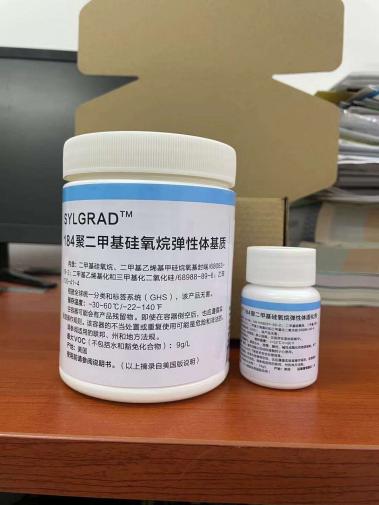
PDMS-微流控基质材料-PDMS/道康宁SYLGARD184-聚二甲基硅氧烷/0.5KG(组)

产品说明书PDF自助在线看:http://www.pdmshub.com/sih

信息更新:

美国总工厂生产的0.5KG原始包装的PDMS延期至2021年9月16日后才能交货,默认我们将发国内库存的进口分装产品(02085925-0.5KG);另受制于有机硅大幅涨价潮影响,2021年9月1日后将上调销售价格,另行通知。Dow Corning=道康宁=Dow SiL=陶氏,都是同一家公司。 2021.09.01更新

美国总工厂生产的0.5KG包装的PDMS恢复正常进口,合法正规,质量金标准,欢迎订购使用。并承诺从我司购买的皆为原厂包装,100%未开封,附带技术手册,非国产灌装仿制、非分装、非仿冒外包装产品,可以放心使用。大量订购更有优惠。2021.04.01更新

备注:由于dowsil与道康宁公司合并,美国总工厂生产的PDMS,价格涨幅高达1倍之多,因针对科研用户使用,特备货规格0.5KG。如果您需要美国总工厂原厂生产的大规格包装的预定,可以与QQ 11366508联系给予报价/货期。2021.05更新

此链接为PDMS-微流控芯片/PDMS/道康宁SYLGARD184/小桶0.5KG装的链接。

一般性的产品性能参数表参考以下小桶装的参数:

微流控芯片/PDMS/道康宁SYLGARD184;微流控芯片/PDMS/道康宁SYLGARD184;微流控芯片/PDMS/道康宁SYLGARD184;

品牌型号:道康宁SYLGARD184

包装规格:0.5KG/罐[含有45.4g固化剂,总重量为0.5KG]

产品颜色:保质期限:36个月

存放环境说明:室温,阴凉处保存

备注说明:

美国道康宁道康宁SYLGARD 184硅橡胶是由液体组分组成的双组分套件产品,包括基本组分与固化剂。基本组分与固化剂按10:1重量比完全混合,中等粘度混合液的稠度与SAE 40机油相似。无论厚薄,混合液将固化成为具有韧性的透明弹性体,最适用于电子/电气方面的封装与灌封应用。 道康宁SYLGARD 184硅橡胶在25~150℃的温度范围内固化,无放热现象,无需二次固化。固化过程完成后,可立即在-55~200℃的温度范围内使用。 产品特性:低毒性,在常规的工业操作中,无特别的注意事项; 无溶剂或固化副产物, 固化时不放热;无需特殊的通风条件,不会产生腐蚀;固化时,收缩量小; 固化后, 透明具有弹性;抗震与减缓机械震动;振动的传递性能小;元件可裸视检查与易修补性; 环保性能;低吸水性,良好的耐辐射性能;高真空状态下的低漏气性; 优异的电性能;较大温度范围内的稳定性, 抗解聚;在-55~200℃范围内,甚至在密闭状态下保持弹性与柔韧性,性能稳定; 阻燃性,UL可燃性分级为94 V-1,温度等级:130℃ 产品用途: 道康宁SYLGARD 184硅橡胶在电气/电子的封装与灌封方面有广泛的应用。