
在PDMS微流控器官芯片中模拟药物浓度。

ty10086 提交于 周三, 08/25/2021 - 15:29
文章英文标题
Simulating drug concentrations in PDMS microfluidic organ chips.
正文
微流控芯片上的器官细胞培养装置由于具有生物相容性、透明性、弹性体性、透氧性等特点,常采用聚二甲基硅氧烷( PDMS )制作;然而,疏水性的小分子能够吸附到PDMS上,这使得预测药物反应具有挑战性。本文介绍了一种模拟和实验相结合的方法,在不知道其log  P值的前提下,预测了PDMS有机芯片中药物连续给药的时空浓度分布。首先,建立了包含吸收、吸附、对流和扩散的芯片内药物损失的三维有限元模型,模拟了药物浓度随时间和空间的变化与PDMS潜在扩散系数和log  P值的关系。通过实验测量化合物在PDMS中的扩散系数,并通过质谱分析通道流出的药物浓度确定其分配系数,可以估算化合物的有效对数 P范围。实验推导了抗疟药物和潜在的SARS-CoV-2治疗药物阿莫地喹的扩散系数和分配系数,并将其应用于模型中,定量估计了人肺气道芯片内药物浓度随时间的分布。同样的策略可以应用于任何设备的几何形状、表面处理或体外微流控模型来模拟药物在3D中的时空梯度,而不需要预先知道PDMS中的分配系数或扩散速率。由此可见,这种方法可能会扩大PDMS Organ Chip器件用于多种形式的药物检测。
文章内容(英文)
Microfluidic organ-on-a-chip (Organ Chip) cell culture devices are often fabricated using polydimethylsiloxane (PDMS) because it is biocompatible, transparent, elastomeric, and oxygen permeable; however, hydrophobic small molecules can absorb to PDMS, which makes it challenging to predict drug responses. Here, we describe a combined simulation and experimental approach to predict the spatial and temporal concentration profile of a drug under continuous dosing in a PDMS Organ Chip containing two parallel channels separated by a porous membrane that is lined with cultured cells, without prior knowledge of its log P value. First, a three-dimensional finite element model of drug loss into the chip was developed that incorporates absorption, adsorption, convection, and diffusion, which simulates changes in drug levels over time and space as a function of potential PDMS diffusion coefficients and log P values. By then experimentally measuring the diffusivity of the compound in PDMS and determining its partition coefficient through mass spectrometric analysis of the drug concentration in the channel outflow, it is possible to estimate the effective log P range of the compound. The diffusion and partition coefficients were experimentally derived for the antimalarial drug and potential SARS-CoV-2 therapeutic, amodiaquine, and incorporated into the model to quantitatively estimate the drug-specific concentration profile over time measured in human lung airway chips lined with bronchial epithelium interfaced with pulmonary microvascular endothelium. The same strategy can be applied to any device geometry, surface treatment, or in vitro microfluidic model to simulate the spatial and temporal gradient of a drug in 3D without prior knowledge of the partition coefficient or the rate of diffusion in PDMS. Thus, this approach may expand the use of PDMS Organ Chip devices for various forms of drug testing.
来源出处
Journal|[J]Lab on a Chip2021.
谷歌学术影响力
[db:学术影响力]
DOI
https://doi.org/10.1039/D1LC00348H

PDMS臻品推荐

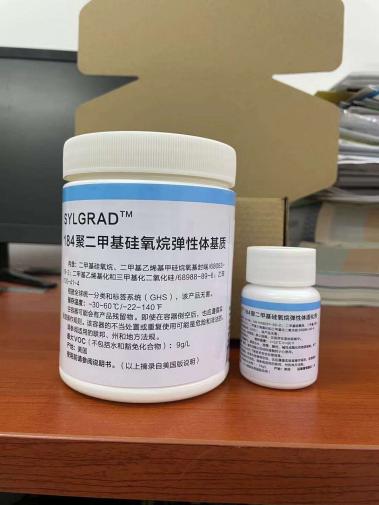
PDMS-微流控基质材料-PDMS/道康宁SYLGARD184-聚二甲基硅氧烷/0.5KG(组)

产品说明书PDF自助在线看:http://www.pdmshub.com/sih

信息更新:

美国总工厂生产的0.5KG原始包装的PDMS延期至2021年9月16日后才能交货,默认我们将发国内库存的进口分装产品(02085925-0.5KG);另受制于有机硅大幅涨价潮影响,2021年9月1日后将上调销售价格,另行通知。Dow Corning=道康宁=Dow SiL=陶氏,都是同一家公司。 2021.09.01更新

美国总工厂生产的0.5KG包装的PDMS恢复正常进口,合法正规,质量金标准,欢迎订购使用。并承诺从我司购买的皆为原厂包装,100%未开封,附带技术手册,非国产灌装仿制、非分装、非仿冒外包装产品,可以放心使用。大量订购更有优惠。2021.04.01更新

备注:由于dowsil与道康宁公司合并,美国总工厂生产的PDMS,价格涨幅高达1倍之多,因针对科研用户使用,特备货规格0.5KG。如果您需要美国总工厂原厂生产的大规格包装的预定,可以与QQ 11366508联系给予报价/货期。2021.05更新

此链接为PDMS-微流控芯片/PDMS/道康宁SYLGARD184/小桶0.5KG装的链接。

一般性的产品性能参数表参考以下小桶装的参数:

微流控芯片/PDMS/道康宁SYLGARD184;微流控芯片/PDMS/道康宁SYLGARD184;微流控芯片/PDMS/道康宁SYLGARD184;

品牌型号:道康宁SYLGARD184

包装规格:0.5KG/罐[含有45.4g固化剂,总重量为0.5KG]

产品颜色:保质期限:36个月

存放环境说明:室温,阴凉处保存

备注说明:

美国道康宁道康宁SYLGARD 184硅橡胶是由液体组分组成的双组分套件产品,包括基本组分与固化剂。基本组分与固化剂按10:1重量比完全混合,中等粘度混合液的稠度与SAE 40机油相似。无论厚薄,混合液将固化成为具有韧性的透明弹性体,最适用于电子/电气方面的封装与灌封应用。 道康宁SYLGARD 184硅橡胶在25~150℃的温度范围内固化,无放热现象,无需二次固化。固化过程完成后,可立即在-55~200℃的温度范围内使用。 产品特性:低毒性,在常规的工业操作中,无特别的注意事项; 无溶剂或固化副产物, 固化时不放热;无需特殊的通风条件,不会产生腐蚀;固化时,收缩量小; 固化后, 透明具有弹性;抗震与减缓机械震动;振动的传递性能小;元件可裸视检查与易修补性; 环保性能;低吸水性,良好的耐辐射性能;高真空状态下的低漏气性; 优异的电性能;较大温度范围内的稳定性, 抗解聚;在-55~200℃范围内,甚至在密闭状态下保持弹性与柔韧性,性能稳定; 阻燃性,UL可燃性分级为94 V-1,温度等级:130℃ 产品用途: 道康宁SYLGARD 184硅橡胶在电气/电子的封装与灌封方面有广泛的应用。