
对聚合物凝胶进行多模态表征,确定测试方法对观测弹性模量的影响

ty10086 提交于 周四, 08/26/2021 - 13:14
文章英文标题
Multi-modal characterization of polymeric gels to determine the influence of testing method on observed elastic modulus
正文
摘要\n对机械复制原生组织的材料的需求推动了各种新型生物材料的开发和表征。然而,由于材料和表征技术的多样性,该领域缺乏共识,没有明确的方法比较不同模式测量的值。这很可能造成了在整个研究社区复制研究结果的困难,最近的证据表明,不同的模式并不能在材料内部产生相同的力学测量,无法在不同的测试平台上进行直接的比较。在此,我们通过分析无侧限压缩、拉伸、流变和微观压痕5种典型的生物材料力学表征技术确定的弹性模量,从宏观层面考察“材料特性”是否具有表征模态特异性,微观上采用纳米压痕。这些分析是在生物应用中常用的两种不同的高分子凝胶——聚二甲基硅氧烷( PDMS )和琼脂糖中进行的。每个被加工成跨越一系列的模量,从生理值到超生理值。所有5种技术在每个材料组中都确定了相同的总体趋势,支持它们欣赏相对模量差异的能力。但是,在不同的模式之间发现了显著的差异,说明了绝对模量值的差异,从而排除了不同表征模式测量值的直接比较。这些观察到的差异可能取决于材料的柔顺性、粘弹性和微观结构。虽然确定这些差异的基本机制超出了本工作的范围,但这些结果证明了每种模态如何影响同一材料的实测模量,以及每种模态对样品材料组成变化的敏感性。
文章内容(英文)
Abstract(#br)Demand for materials that mechanically replicate native tissue has driven development and characterization of various new biomaterials. However, a consequence of materials and characterization technique diversity is a lack of consensus within the field, with no clear way to compare values measured via different modalities. This likely contributes to the difficulty in replicating findings across the research community; recent evidence suggests that different modalities do not yield the same mechanical measurements within a material, and direct comparisons cannot be made across different testing platforms. Herein, we examine whether “material properties” are characterization modality-specific by analyzing the elastic moduli determined by five typical biomaterial mechanical characterization techniques: unconfined-compression, tensiometry, rheometry, and micro-indentation at the macroscopic level, and microscopically using nanoindentation. These analyses were performed in two different polymeric gels frequently used for biological applications, polydimethylsiloxane (PDMS) and agarose. Each was fabricated to span a range of moduli, from physiologic to supraphysiologic values. All five techniques identified the same overall trend within each material group, supporting their ability to appreciate relative moduli differences. However, significant differences were found across modalities, illustrating a difference in absolute moduli values, and thereby precluding direct comparison of measurements from different characterization modalities. These observed differences may depend on material compliance, viscoelasticity, and microstructure. While determining the underlying mechanism(s) of these differences was beyond the scope of this work, these results demonstrate how each modality affects the measured moduli of the same material, and the sensitivity of each modality to changes in sample material composition.
来源出处
Journal|[J]Journal of the Mechanical Behavior of Biomedical Materials2019.
DOI
https://doi.org/10.1016/j.jmbbm.2019.01.003

PDMS臻品推荐

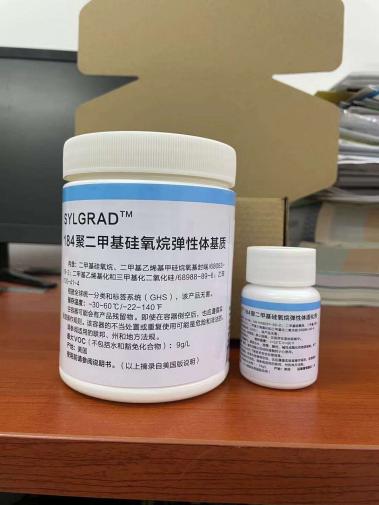
PDMS-微流控基质材料-PDMS/道康宁SYLGARD184-聚二甲基硅氧烷/0.5KG(组)

产品说明书PDF自助在线看:http://www.pdmshub.com/sih

信息更新:

美国总工厂生产的0.5KG原始包装的PDMS延期至2021年9月16日后才能交货,默认我们将发国内库存的进口分装产品(02085925-0.5KG);另受制于有机硅大幅涨价潮影响,2021年9月1日后将上调销售价格,另行通知。Dow Corning=道康宁=Dow SiL=陶氏,都是同一家公司。 2021.09.01更新

美国总工厂生产的0.5KG包装的PDMS恢复正常进口,合法正规,质量金标准,欢迎订购使用。并承诺从我司购买的皆为原厂包装,100%未开封,附带技术手册,非国产灌装仿制、非分装、非仿冒外包装产品,可以放心使用。大量订购更有优惠。2021.04.01更新

备注:由于dowsil与道康宁公司合并,美国总工厂生产的PDMS,价格涨幅高达1倍之多,因针对科研用户使用,特备货规格0.5KG。如果您需要美国总工厂原厂生产的大规格包装的预定,可以与QQ 11366508联系给予报价/货期。2021.05更新

此链接为PDMS-微流控芯片/PDMS/道康宁SYLGARD184/小桶0.5KG装的链接。

一般性的产品性能参数表参考以下小桶装的参数:

微流控芯片/PDMS/道康宁SYLGARD184;微流控芯片/PDMS/道康宁SYLGARD184;微流控芯片/PDMS/道康宁SYLGARD184;

品牌型号:道康宁SYLGARD184

包装规格:0.5KG/罐[含有45.4g固化剂,总重量为0.5KG]

产品颜色:保质期限:36个月

存放环境说明:室温,阴凉处保存

备注说明:

美国道康宁道康宁SYLGARD 184硅橡胶是由液体组分组成的双组分套件产品,包括基本组分与固化剂。基本组分与固化剂按10:1重量比完全混合,中等粘度混合液的稠度与SAE 40机油相似。无论厚薄,混合液将固化成为具有韧性的透明弹性体,最适用于电子/电气方面的封装与灌封应用。 道康宁SYLGARD 184硅橡胶在25~150℃的温度范围内固化,无放热现象,无需二次固化。固化过程完成后,可立即在-55~200℃的温度范围内使用。 产品特性:低毒性,在常规的工业操作中,无特别的注意事项; 无溶剂或固化副产物, 固化时不放热;无需特殊的通风条件,不会产生腐蚀;固化时,收缩量小; 固化后, 透明具有弹性;抗震与减缓机械震动;振动的传递性能小;元件可裸视检查与易修补性; 环保性能;低吸水性,良好的耐辐射性能;高真空状态下的低漏气性; 优异的电性能;较大温度范围内的稳定性, 抗解聚;在-55~200℃范围内,甚至在密闭状态下保持弹性与柔韧性,性能稳定; 阻燃性,UL可燃性分级为94 V-1,温度等级:130℃ 产品用途: 道康宁SYLGARD 184硅橡胶在电气/电子的封装与灌封方面有广泛的应用。