
提高微模板对单细胞分析的鲁棒性

ty10086 提交于 周四, 08/26/2021 - 12:52
文章英文标题
Improving the robustness of microstencils for single-cell analysis
正文
鉴于细胞表型在群体水平上的高度变异,越来越多的研究人员转向单细胞分析,以更好地理解细胞和疾病功能。然而,对单个细胞的处理和操纵仍然具有挑战性和昂贵性。例如,一种叫做“微接触印刷”的方法将蛋白质印在培养表面,但这个过程复杂、缓慢且效率低下。作为一种替代方法,新的文章提出了一种制备结构稳健的单细胞分析用微模板的新技术,该技术具有成本低、通用性强、重复性好等优点。由聚合物聚二甲基硅氧烷( PDMS )构筑的微模板在几个月内可重复使用数十次,磨损最小。虽然微模板图案的制作并不新鲜,但由于模板的易碎性,这种方法已经被淘汰,有利于微接触印刷。微纤膜的厚度只有30 ~ 40微米。为了增加膜强度,作者在花纹截面周围画了毫米厚的PDMS边界。因此,在保持模板区域很薄的同时,膜被加强。为了验证这种方法的有效性,作者选择性地将一个疏水的培养皿——细胞通常不会粘附在这个培养皿上——通过微模板接触氧等离子体。这一过程创造了与任何期望形状和尺寸的模板孔相对应的亲水性岛屿。细胞被接种到这些岛屿,并停留在其边界内。作者希望其他研究者将采用这种简单可靠的方法对模式细胞进行广泛的未来研究。资料来源:Khadija Zaidi和Nitin Agrawal,Biomicrofluidics ( 2018 )的\"基于Microstencil的空间固定单个细胞分析\"。文章可在https://doi.org/10.1063/1.5061922.访问
文章内容(英文)
Given the high variation of cell phenotypes at the population level, a growing number of researchers have turned to single-cell analysis to better understand cell and disease functions. However, handling and manipulation of individual cells remains challenging and expensive. For instance, a method called “microcontact printing” stamps proteins onto the culture surfaces, but the process is complex, slow and inefficient.As an alternative approach, a new article presents a novel technique to fabricate structurally robust microstencils for single-cell analysis that is cost-effective, versatile and reproducible. The microstencils, constructed out of the polymer polydimethylsiloxane (PDMS), can be reused dozens of times over several months with minimal wear.While microstencil patterning is not new, the method has been eschewed in favor of microcontact printing due to the fragility of stencils that would often break. The thickness of a microstencil membrane is only 30 to 40 microns. To increase membrane strength, the authors painted a millimeter-thick border of PDMS around the patterned section. Thus, the membrane is reinforced while keeping the stencil area very thin. To validate the effectiveness of this approach, the authors selectively exposed a hydrophobic petri dish — to which cells do not normally adhere — to oxygen plasma through the microstencil. This process created hydrophilic islands corresponding to the stencil holes of any desired shape and dimensions. Cells were seeded to these islands and stayed within their boundaries.The authors hope that other researchers will adopt this simple and reliable approach to pattern cells for a wide range of future studies.Source: “Microstencil-based spatial immobilization of individual cells for single cell analysis,” by Khadija Zaidi and Nitin Agrawal, Biomicrofluidics (2018). The article can be accessed at https://doi.org/10.1063/1.5061922.
来源出处
Journal|[J]ScilightVolume 2018, Issue 48. 2018. PP 480004
DOI
https://doi.org/10.1063/1.5082923

PDMS臻品推荐

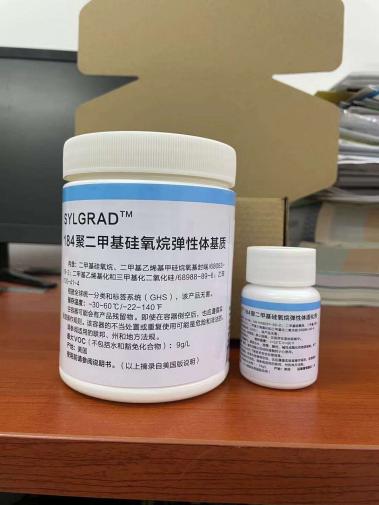
PDMS-微流控基质材料-PDMS/道康宁SYLGARD184-聚二甲基硅氧烷/0.5KG(组)

产品说明书PDF自助在线看:http://www.pdmshub.com/sih

信息更新:

美国总工厂生产的0.5KG原始包装的PDMS延期至2021年9月16日后才能交货,默认我们将发国内库存的进口分装产品(02085925-0.5KG);另受制于有机硅大幅涨价潮影响,2021年9月1日后将上调销售价格,另行通知。Dow Corning=道康宁=Dow SiL=陶氏,都是同一家公司。 2021.09.01更新

美国总工厂生产的0.5KG包装的PDMS恢复正常进口,合法正规,质量金标准,欢迎订购使用。并承诺从我司购买的皆为原厂包装,100%未开封,附带技术手册,非国产灌装仿制、非分装、非仿冒外包装产品,可以放心使用。大量订购更有优惠。2021.04.01更新

备注:由于dowsil与道康宁公司合并,美国总工厂生产的PDMS,价格涨幅高达1倍之多,因针对科研用户使用,特备货规格0.5KG。如果您需要美国总工厂原厂生产的大规格包装的预定,可以与QQ 11366508联系给予报价/货期。2021.05更新

此链接为PDMS-微流控芯片/PDMS/道康宁SYLGARD184/小桶0.5KG装的链接。

一般性的产品性能参数表参考以下小桶装的参数:

微流控芯片/PDMS/道康宁SYLGARD184;微流控芯片/PDMS/道康宁SYLGARD184;微流控芯片/PDMS/道康宁SYLGARD184;

品牌型号:道康宁SYLGARD184

包装规格:0.5KG/罐[含有45.4g固化剂,总重量为0.5KG]

产品颜色:保质期限:36个月

存放环境说明:室温,阴凉处保存

备注说明:

美国道康宁道康宁SYLGARD 184硅橡胶是由液体组分组成的双组分套件产品,包括基本组分与固化剂。基本组分与固化剂按10:1重量比完全混合,中等粘度混合液的稠度与SAE 40机油相似。无论厚薄,混合液将固化成为具有韧性的透明弹性体,最适用于电子/电气方面的封装与灌封应用。 道康宁SYLGARD 184硅橡胶在25~150℃的温度范围内固化,无放热现象,无需二次固化。固化过程完成后,可立即在-55~200℃的温度范围内使用。 产品特性:低毒性,在常规的工业操作中,无特别的注意事项; 无溶剂或固化副产物, 固化时不放热;无需特殊的通风条件,不会产生腐蚀;固化时,收缩量小; 固化后, 透明具有弹性;抗震与减缓机械震动;振动的传递性能小;元件可裸视检查与易修补性; 环保性能;低吸水性,良好的耐辐射性能;高真空状态下的低漏气性; 优异的电性能;较大温度范围内的稳定性, 抗解聚;在-55~200℃范围内,甚至在密闭状态下保持弹性与柔韧性,性能稳定; 阻燃性,UL可燃性分级为94 V-1,温度等级:130℃ 产品用途: 道康宁SYLGARD 184硅橡胶在电气/电子的封装与灌封方面有广泛的应用。