General discussion

ty10086 提交于 周四, 08/26/2021 - 12:54
文章英文标题
General discussion
正文
GENERAL DISCUSSIONProf. A. Silberberg (Weizmmn Institute of Science, Israel) said: In the usualmethod of deriving the Flory-Huggins expression,l a long-chain, linear, highlyflexible structure for the solute molecule is assumed. This, however, is not arequirement and a more general derivation can be given., One assumes mixing with-out volume change and divides the solute molecule, arbitrarily, into r subunits equalin size to the solvent molecule. This subdivision is completely conceptual and weassume that upon mixing with solvent each one out of the set of r sub-units, whileremembering its topological connection to the others, can occupy any position in thespace available for the mixture, i.e., can become arbitrarily far separated from theothers. It follows that n1 solvent molecules of volume V,, and n2 solute molecules ofvolume rV, (subdivided as above) can be distributed over a space of total volume,V = nlVl+m2Vl (1)in (n, +m2)! distinguishable ways if all the solvent molecules and all the solutemolecules and their sub-units are regarded as distinguishable.Dropping the distinction among solvent molecules and among solute moleculebut maintaining distinguishability within each set of sub-units composing a solutemolecule, i.e., retaining the topological, if not the physical, connectivity of eachsolute molecule, reduces the number of distinguishable arrangement to(2) (n, + m,) ! In, ! n, !To correct this expression for the dismemberment of the solute molecules we mayargue as follows.In (2) it is assumed that each solute subunit has the entire volumeVat its disposal irrespective of the real structural restrictions.This can be true onlyfor one, say the first, sub-unit in the solute molecule, the other (r - 1) sub-units arerestricted in some way to a parametric volume V* associated with the first sub-unitand not to the total volume V. Hence we have overestimated the number of con-figurations in (2) by a factor (V*/V\u003enz(\"-l). With this correction we arrive at thefollowing expression for the microcanonical partition function of the mixture :(3)where u), and u)= are mixture-independent factors associated with each solvent andsolute molecule respectively. We now use (3) to write the microcanonical partitionfunction for the unmixed species 1 and 2 respectively :R(n,, 11,) = o ~ ~ o ~ [ ( ~ ~ + rn,) !Inl !n, !](V*/V)nz(r- '1,which together with (3) give for the free energy of mixing (no internal energy change isassumed)AG = kTIn [a(n,)~(nl\u003e/~(n,, n2)l= kT In [nl ! (m2)!/(nl +rn2)!][(nl +rn2)/(rn,)]\"2(r- l )= (n, + rn2)kT[x1 In u1 + x2 In 24, (5)'see, e.g., C.Tanford, Physical Chemistry of Macromolecules (John Wiley, New York, 1961),p. 204.A. Silberberg, J. Chem. Phys., 1968, 48,2835, appendix.1 6GENERAL DISCUSSION 163where x1 and x2 are the mole fractions and u1 and u2 are the volume fraction of thecomponents.The Flory-Huggins mixing equation (5) was thus derived without detailed specifica-tion of how the solute molecules are built up. The derivation depends only on theassumption that a parameter V* exists that (V*/ V)n2(r- l) is an adequate correctionfactor for connectivity and most important that the parameter V* does not change ingoing from the unmixed state of pure 2 to the mixture.Mr.C. P . Hicks (Uniuersity of Bristol) (communicated): It has sometimes beensuggested that partial molar volumes should be used in the calculation of volumefractions in the place of the molar volumes of the pure components. While it isimpossible to say that it is correct to use pure data, it is certainly wrong to use partialmolar volumes instead. The relationship V, = xlvl +x2V2 must not be taken tosuggest that is the effective volume of component i in the mixture, i.e., the partof the total volume occupied by, or to be ascribed to,l component i.In fact, thepartial molar volume need not bear any particular relationship to the effective volume ;the former merely shows how the total volume will change for vanishingly smallincrements of the component. This is not a fine distinction : consider the extremesize difference case mentioned in Rowlinson’s paper where small molecules (1) arefitted into the spaces between large molecules (2). Here, until a certain criticalconcentration of 1 is reached, Vl = 0, but this is clearly not the volume which themolecules of 1 occupy. After this point, vl tends to the pure molar volume of 1,reaching it at once if the size ratio is large enough.This naive argument, based on a well-ordered structure, is difficult to extend to afluid, but there is experimental evidence to show that occasionally Vl\u003cO, as, e.g.,near the liquid-vapour critical point in methane + propane,2 methane + i-~entane,~methane + 2-methylpentane and ethane + n-~entane,~ all of which are “ simple ”systems.The use of partial molar volumes to assess effective volumes will sometimeslead to nonsensical values, and even when they are not so I suggest that it would bebetter to use the pure molar volumes as a not necessarily accurate estimate of theeffective volume of each component.Dr. H . Tompa (Union Carbide European Research Associates, Brussels) said :Flory has referred to an old suggestion of mine to consider the effects of a possibleconcentration dependence of the interaction parameter, though this suggestion hasalso been made by others.This encourages me to bring up another old suggestionof mine, also not original since it has also been made before by others, in particularby Munster : all theories of polymer solutions assume that the force field around themolecules or polymer segments is spherical, in other words, that there are noorientation effects. However, clearly the interaction energy, e.g., of two molecules ofbenzene depends on whether the molecules are “ face to face ” or ‘‘ face to edge ” or“ edge to edge ’’ or in any other mutual orientation, and the same applies, e.g., tothe phenyl group of polystyrene. The mixing of two components will interfere withthe state of orientation and will lead in particular to an additional term in the entropyof mixing.5 I would suggest that the discrepancies with experiment which remaineven in the greatly refined theory which Flory has just presented might well be due tosuch orientation effects.J.S. Rowlinson, Liquids and Liquid Mixtures, 2nd ed. (Butterworth, London, 1969), p. 106.* P. L. Chueh and J. M. Prauznitz, Ameu. Znst. Chem. Eng. J., 1967, 13, 1099.A. J. Davenport, J. S. Rowlinson and G. Saville, Trans. Faraduy SOC., 1966,62, 322.H. H. Reamer, V. Berry and B. H. Sage, J . Chem. Eng. Data, 1961, 6,185.H. Tompa, J. Chem. Phys., 1953, 21, 250164 GENERAL DISCUSSIONDr. R. F. T. Stepto (University of Mmchester) said: In agreement with Flory'sremarks, one believes that since the advent and acceptance of the rotational-isomericstate model for real polymer chains, the problem of excluded volume could beapproached more meaningfully by using this model than by using lattice models.Using the rotational-isomeric state model and Lennard-Jones expressions for theenergies of interaction between segments we have obtained preliminary results whichindicate that the value of the exponent y depends to a large extent on the actualLennard-Jones parameters used.Prof. R.L. Scott (University of California, Los Angeles) said: Flory has reporteddifficulties in fitting the thermodynamic properties of solutions of polydimethyl-siloxanes to his equation of state theory with a single parameter XI2. Similardifficulties were encountered by S. P. Koh working with Prof. G. N. Malcolm inNew Zealand.In their unpublished work on polydimethylsiloxane in CCl, andCHC13, they found it necessary to assume different values of X12 to fit GE, RE, and rE. I suggest that part of the difficulty may arise from the fact that polydimethyl-siloxane is a very bulky molecule with a chain cross-section much larger than thatof a solvent molecule. In such a case the usual Flory-Huggins configurational termis appreciably in error and contributes too large a term to the excess entropy.Adjusting X12, which is essentially an energy parameter, is insufficient and a secondparameter for the local configurational entropy (as distinct from equation of stateeffects) may be necessary.Prof. G. N. Malcolm (Massey University, New Zealand) (communicated): Theresults obtained by Dr.S. P. Koh for solutions of polydimethylsiloxane (PDMS)(with number average relative molecular mass of 1655+30) in CCl, and CHC13 aresummarized in the following table. The mixing functions are expressed as the totalchange in the property on mixing divided by the total volume of the unmixedcomponents.Scott has described our experience in attempting to fit these results to the equationof state theory of Flory.MAXIMUM VALUES OF MIXING FUNCTIONS AT 278.68 K AND 1 atm.system AmHmax/J cm-3 AmGmax/J cm-3 103AmV/cm3 cm- 3*0.10 f 0.25 f 008PDMS (A)+ CCI, (B) 0.06 at $A = 0.35PDMS (A)+ CHC13 (B) 0.14 at ( b ~ = 0.55- 5.89 at $A = 0.70- 5.50 at +A = 0.75- 2.13 at 4~ = 0.60- 3.83 at @A = 0.60Prof. P. J. Flory (Stanford University) said : I agree with Scott that a large disparitybetween the diameter of the polymer chain and that of the solvent should affect theentropy of mixing. The diameter of the PDMS chain is comparatively large, and insolutions of PDMS with CHC13 or CCl, this difference may act to diminish the entropyof mixing.But in the systems PDMS + cyclohexane and PDMS + chlorobenzenethis difference is not great. Moreover, the excess volume as well as the entropydepart from our theory. The former would not be altered by modification of thecombinatorial entropy. Hence, we must look elsewhere for the explanation of thediscrepancy between theory and experiment in this case.Dr. M. L. Huggins (Arcadia Institute for Scientijic Research l) said: For comparisonwith other theories, I outline briefly my new theory of the thermodynamic properties135 Northridge Lane, Woodside, Calif.94062GENERAL DISCUSSION 165of solutions.' It is based on concepts I have previously discussed with regard topolymer solutions, but is simplified by omission of some factors that are usuallyunimportant.Like Flory in his new theory, outlined in the Spiers Memorial Lecture, I deal withsegment surfaces, but the surface area that enters into the equations is the averagearea that makes contact with other surfaces. The energies in the equations are theaverage contact energies per unit area of contact, for each type of contact. For asystem containing two types of segments there are three types of contact. I assumethe relative contact areas for these three types to be governed by an equilibriumconstant, equal to unity for randomness of contacts.With these assumptions, equations are deduced for the total energy of the systemand derived quantities as functions of the variables mentioned.For excess enthalpiesof mixing the contact energies enter only as the energy change for replacement ofcontacts between like segments by contacts between unlike segments. Similarly, theequations for excess volumes of mixing involve the volume change when contactsbetween like segments are replaced by contacts between unlike segments. UnlikeFlory, I do not assume the energy and volume change parameters to be the same;each is deduced from experimental data.An important feature of my theory is the transferability of the magnitudes of theparameters from one system to another containing the same segment types.Thistheory gives excellent agreement with experiment, when tested by good data on avariety of systems.Prof. J. D. Ghmez-Ibhiiez ( WesZeyan University, Conn.) said : Relative to solutionsin which n-alkanes are one of the components, it may be of interest to report somerecent measurements on binary mixtures of cyclohexane with n-alkanes carried outin our laboratory which together with others, available in the literature, may permitmaking some generalizations about the effect of chain length on the excess thermo-dynamic functions. We have measured the enthalpies of mixing of cyclohexanewith n-nonane and with n-dodecane. Similar measurements have been made byLundberg with n-heptane and with n-hexadecane.In all four cases the enthalpiesof mixing are positive and increase in magnitude with increasing length of the alkane,being in fact a linear function of n, the number of carbons in the chain. For a givenalkane the magnitude of HE decreases with increasing temperature, this effect beingmore pronounced as the length of the alkane increases.Our recent measurements of the excess Gibbs free energy of mixing of cyclo-hexane with n-eicosane, together with our previous ones with n-hexadecane andwith n-dodecane show a similar linear dependence on chain length, and the threebinary systems exhibit also a relation of congruence. In all three cases GE is negative,and increases in absolute value with increasing length of the alkane.For a givenalkane, GE becomes more negative with increasing temperature. The excess volumesof these mixtures, on the other hand, are positive and linear function (around themaximum) not of n, but of l / n . 5It may be of interest to report also on some preliminary results obtained for the sys-tems formed by n-hexadecane with 2,2,4-trimethylpentane and with transdecaline. Forthe first system, GE is small but positive, also decreasing with increasing temperature,M. L. Huggins, J. Phys. Chem., 1970, 74, 371.G. W. Lundberg, J. Chem. Eng. Data, 1964,9, 193.J. D. G6mez-IbBfiez and J. J. C. Shieh, J. Phys. Chem., 1965,69, 1660.J. D. G6mez-IbAiiez, J. J. C. Shieh and E. M. Thorsteinson, J . Phys. Chem., 1966, 70, 1998.J.D. G6mez-IbAfiez and C. T. Liu, J . Phys. Chem., 1961, 65,2148166 GENERAL DISCUSSIONand HE has a value of about 200 J for the equimolar mixture at 25”. For thesecond system GE is about zero at 25” and HE is about 50 J at x = 0.5. We believethat these type of measurements may yield valuable empirical information which mayhelp to elucidate the effect size and shape, previously referred to in this Discussion,may have on the excess thermodynamic functions.For the mixtures formed by cyclohexane with n-alkanes we have calculated, fromequations of state, and also following the procedure of Abe and Flory,, theparameter X I , of Flory’s theory. We find that the value for X , , thus calculatedpredicts rather well the experimental values for GE, but the predictions for the excessenthalpies, entropies and volumes of mixing are much less satisfactory.Dr. C.L. Young (University of Leeds) said : Fig. 2 of Scott and van Konynenburgis in surprisingly good agreement with the experimental data for hydrocarbons butthe boundaries between type 11, I11 and IV behaviour are strongly dependent on thecombining rule for a12. The van der Waals combining rule for a,, appears to befairly accurate for mixtures of widely differing size molecules. It may be comparedwith the geometric mean and Hudson and McCoubrey combining rules for theinteraction parameter E , ~ :a,2/o:za = E12(vdW) = ~:/,’~~~~[o:/l”o:/2”/~~,]~, van der Waals;q2(G.M.) = ~:/1~~;/22, geometric mean;E~ ,(H.M.) = E: i2\u0026:(2, [o: /:o~/z”lo, ,16j”, Hudson and McCoubrey,TABLE COMPARISON OF CALCULATED AND EXPERIMENTAL VALUES OF \u003csystem no.van der WaalsOMCTS (a)+ cyclopentane 1 0.937OMCTS+ cyclohexane 2 0.953OMCTS+ cycloheptane 3 0.964OMCTS+ cyclo-octane 4 0.974OMCTS + 2,3-dimethylbutane 5 0.965OMCTS+ benzene 6 0.938OMCTS+ carbontetrachloride 7 0.943ethane+ n-heptane 8 0.955propane+ n-octane 9 0.968n-pentane + n-tridecane 10 0.966n-hexane+ nitrogen 11 0.921n-hexme+ methane 12 0.932n-pentane + methane 13 0.947argon + methane 14 0.978(a) OMCTS = octamethylcyclotetrasiloxane.(b) assuming the ionization potentials are the same.Hudson andMcCoubrey (h)0.878 (b)0.907 (6)0.929 (b)0.948 (6)0.930 (b)0.879 (b)0.889 (6)0.9100.9370.9340.8330.8620.8910.952experimental0.935 (c)0.961 (c)0.979 (c)0.981 (c)0.968 (c)0.940 (c)0.953 (c)0.945 (d)0.972 (d)0.983 (c)0.87 (e)0.96 (f 10.97 (f)0.981 (9)(c) unpublished results obtained from critical temperature data.(d) obtained from critical temperature data taken from sources given in C.P. Hicks and C. L.( e ) obtained from virial coefficients, C. L. Young, Ph.D. Thesis, (University of Bristol, 1967).cf) obtained from virial coefficients data of E. M. Dantzler, C. M. Knobler and M. L. Windsor,(9) obtained from free energy of mixing data, T. W. Leland, J. S. Rowlinson, G. A. Sather and(h) G. M. Hudson and J. C. McCoubrey, Trans. Furahy SOC., 1960,56,76

文章内容(英文)
GENERAL DISCUSSIONProf. A. Silberberg (Weizmmn Institute of Science, Israel) said: In the usualmethod of deriving the Flory-Huggins expression,l a long-chain, linear, highlyflexible structure for the solute molecule is assumed. This, however, is not arequirement and a more general derivation can be given., One assumes mixing with-out volume change and divides the solute molecule, arbitrarily, into r subunits equalin size to the solvent molecule. This subdivision is completely conceptual and weassume that upon mixing with solvent each one out of the set of r sub-units, whileremembering its topological connection to the others, can occupy any position in thespace available for the mixture, i.e., can become arbitrarily far separated from theothers. It follows that n1 solvent molecules of volume V,, and n2 solute molecules ofvolume rV, (subdivided as above) can be distributed over a space of total volume,V = nlVl+m2Vl (1)in (n, +m2)! distinguishable ways if all the solvent molecules and all the solutemolecules and their sub-units are regarded as distinguishable.Dropping the distinction among solvent molecules and among solute moleculebut maintaining distinguishability within each set of sub-units composing a solutemolecule, i.e., retaining the topological, if not the physical, connectivity of eachsolute molecule, reduces the number of distinguishable arrangement to(2) (n, + m,) ! In, ! n, !To correct this expression for the dismemberment of the solute molecules we mayargue as follows.In (2) it is assumed that each solute subunit has the entire volumeVat its disposal irrespective of the real structural restrictions.This can be true onlyfor one, say the first, sub-unit in the solute molecule, the other (r - 1) sub-units arerestricted in some way to a parametric volume V* associated with the first sub-unitand not to the total volume V. Hence we have overestimated the number of con-figurations in (2) by a factor (V*/V\u003enz(\"-l). With this correction we arrive at thefollowing expression for the microcanonical partition function of the mixture :(3)where u), and u)= are mixture-independent factors associated with each solvent andsolute molecule respectively. We now use (3) to write the microcanonical partitionfunction for the unmixed species 1 and 2 respectively :R(n,, 11,) = o ~ ~ o ~ [ ( ~ ~ + rn,) !Inl !n, !](V*/V)nz(r- '1,which together with (3) give for the free energy of mixing (no internal energy change isassumed)AG = kTIn [a(n,)~(nl\u003e/~(n,, n2)l= kT In [nl ! (m2)!/(nl +rn2)!][(nl +rn2)/(rn,)]\"2(r- l )= (n, + rn2)kT[x1 In u1 + x2 In 24, (5)'see, e.g., C.Tanford, Physical Chemistry of Macromolecules (John Wiley, New York, 1961),p. 204.A. Silberberg, J. Chem. Phys., 1968, 48,2835, appendix.1 6GENERAL DISCUSSION 163where x1 and x2 are the mole fractions and u1 and u2 are the volume fraction of thecomponents.The Flory-Huggins mixing equation (5) was thus derived without detailed specifica-tion of how the solute molecules are built up. The derivation depends only on theassumption that a parameter V* exists that (V*/ V)n2(r- l) is an adequate correctionfactor for connectivity and most important that the parameter V* does not change ingoing from the unmixed state of pure 2 to the mixture.Mr.C. P . Hicks (Uniuersity of Bristol) (communicated): It has sometimes beensuggested that partial molar volumes should be used in the calculation of volumefractions in the place of the molar volumes of the pure components. While it isimpossible to say that it is correct to use pure data, it is certainly wrong to use partialmolar volumes instead. The relationship V, = xlvl +x2V2 must not be taken tosuggest that is the effective volume of component i in the mixture, i.e., the partof the total volume occupied by, or to be ascribed to,l component i.In fact, thepartial molar volume need not bear any particular relationship to the effective volume ;the former merely shows how the total volume will change for vanishingly smallincrements of the component. This is not a fine distinction : consider the extremesize difference case mentioned in Rowlinson’s paper where small molecules (1) arefitted into the spaces between large molecules (2). Here, until a certain criticalconcentration of 1 is reached, Vl = 0, but this is clearly not the volume which themolecules of 1 occupy. After this point, vl tends to the pure molar volume of 1,reaching it at once if the size ratio is large enough.This naive argument, based on a well-ordered structure, is difficult to extend to afluid, but there is experimental evidence to show that occasionally Vl\u003cO, as, e.g.,near the liquid-vapour critical point in methane + propane,2 methane + i-~entane,~methane + 2-methylpentane and ethane + n-~entane,~ all of which are “ simple ”systems.The use of partial molar volumes to assess effective volumes will sometimeslead to nonsensical values, and even when they are not so I suggest that it would bebetter to use the pure molar volumes as a not necessarily accurate estimate of theeffective volume of each component.Dr. H . Tompa (Union Carbide European Research Associates, Brussels) said :Flory has referred to an old suggestion of mine to consider the effects of a possibleconcentration dependence of the interaction parameter, though this suggestion hasalso been made by others.This encourages me to bring up another old suggestionof mine, also not original since it has also been made before by others, in particularby Munster : all theories of polymer solutions assume that the force field around themolecules or polymer segments is spherical, in other words, that there are noorientation effects. However, clearly the interaction energy, e.g., of two molecules ofbenzene depends on whether the molecules are “ face to face ” or ‘‘ face to edge ” or“ edge to edge ’’ or in any other mutual orientation, and the same applies, e.g., tothe phenyl group of polystyrene. The mixing of two components will interfere withthe state of orientation and will lead in particular to an additional term in the entropyof mixing.5 I would suggest that the discrepancies with experiment which remaineven in the greatly refined theory which Flory has just presented might well be due tosuch orientation effects.J.S. Rowlinson, Liquids and Liquid Mixtures, 2nd ed. (Butterworth, London, 1969), p. 106.* P. L. Chueh and J. M. Prauznitz, Ameu. Znst. Chem. Eng. J., 1967, 13, 1099.A. J. Davenport, J. S. Rowlinson and G. Saville, Trans. Faraduy SOC., 1966,62, 322.H. H. Reamer, V. Berry and B. H. Sage, J . Chem. Eng. Data, 1961, 6,185.H. Tompa, J. Chem. Phys., 1953, 21, 250164 GENERAL DISCUSSIONDr. R. F. T. Stepto (University of Mmchester) said: In agreement with Flory'sremarks, one believes that since the advent and acceptance of the rotational-isomericstate model for real polymer chains, the problem of excluded volume could beapproached more meaningfully by using this model than by using lattice models.Using the rotational-isomeric state model and Lennard-Jones expressions for theenergies of interaction between segments we have obtained preliminary results whichindicate that the value of the exponent y depends to a large extent on the actualLennard-Jones parameters used.Prof. R.L. Scott (University of California, Los Angeles) said: Flory has reporteddifficulties in fitting the thermodynamic properties of solutions of polydimethyl-siloxanes to his equation of state theory with a single parameter XI2. Similardifficulties were encountered by S. P. Koh working with Prof. G. N. Malcolm inNew Zealand.In their unpublished work on polydimethylsiloxane in CCl, andCHC13, they found it necessary to assume different values of X12 to fit GE, RE, and rE. I suggest that part of the difficulty may arise from the fact that polydimethyl-siloxane is a very bulky molecule with a chain cross-section much larger than thatof a solvent molecule. In such a case the usual Flory-Huggins configurational termis appreciably in error and contributes too large a term to the excess entropy.Adjusting X12, which is essentially an energy parameter, is insufficient and a secondparameter for the local configurational entropy (as distinct from equation of stateeffects) may be necessary.Prof. G. N. Malcolm (Massey University, New Zealand) (communicated): Theresults obtained by Dr.S. P. Koh for solutions of polydimethylsiloxane (PDMS)(with number average relative molecular mass of 1655+30) in CCl, and CHC13 aresummarized in the following table. The mixing functions are expressed as the totalchange in the property on mixing divided by the total volume of the unmixedcomponents.Scott has described our experience in attempting to fit these results to the equationof state theory of Flory.MAXIMUM VALUES OF MIXING FUNCTIONS AT 278.68 K AND 1 atm.system AmHmax/J cm-3 AmGmax/J cm-3 103AmV/cm3 cm- 3*0.10 f 0.25 f 008PDMS (A)+ CCI, (B) 0.06 at $A = 0.35PDMS (A)+ CHC13 (B) 0.14 at ( b ~ = 0.55- 5.89 at $A = 0.70- 5.50 at +A = 0.75- 2.13 at 4~ = 0.60- 3.83 at @A = 0.60Prof. P. J. Flory (Stanford University) said : I agree with Scott that a large disparitybetween the diameter of the polymer chain and that of the solvent should affect theentropy of mixing. The diameter of the PDMS chain is comparatively large, and insolutions of PDMS with CHC13 or CCl, this difference may act to diminish the entropyof mixing.But in the systems PDMS + cyclohexane and PDMS + chlorobenzenethis difference is not great. Moreover, the excess volume as well as the entropydepart from our theory. The former would not be altered by modification of thecombinatorial entropy. Hence, we must look elsewhere for the explanation of thediscrepancy between theory and experiment in this case.Dr. M. L. Huggins (Arcadia Institute for Scientijic Research l) said: For comparisonwith other theories, I outline briefly my new theory of the thermodynamic properties135 Northridge Lane, Woodside, Calif.94062GENERAL DISCUSSION 165of solutions.' It is based on concepts I have previously discussed with regard topolymer solutions, but is simplified by omission of some factors that are usuallyunimportant.Like Flory in his new theory, outlined in the Spiers Memorial Lecture, I deal withsegment surfaces, but the surface area that enters into the equations is the averagearea that makes contact with other surfaces. The energies in the equations are theaverage contact energies per unit area of contact, for each type of contact. For asystem containing two types of segments there are three types of contact. I assumethe relative contact areas for these three types to be governed by an equilibriumconstant, equal to unity for randomness of contacts.With these assumptions, equations are deduced for the total energy of the systemand derived quantities as functions of the variables mentioned.For excess enthalpiesof mixing the contact energies enter only as the energy change for replacement ofcontacts between like segments by contacts between unlike segments. Similarly, theequations for excess volumes of mixing involve the volume change when contactsbetween like segments are replaced by contacts between unlike segments. UnlikeFlory, I do not assume the energy and volume change parameters to be the same;each is deduced from experimental data.An important feature of my theory is the transferability of the magnitudes of theparameters from one system to another containing the same segment types.Thistheory gives excellent agreement with experiment, when tested by good data on avariety of systems.Prof. J. D. Ghmez-Ibhiiez ( WesZeyan University, Conn.) said : Relative to solutionsin which n-alkanes are one of the components, it may be of interest to report somerecent measurements on binary mixtures of cyclohexane with n-alkanes carried outin our laboratory which together with others, available in the literature, may permitmaking some generalizations about the effect of chain length on the excess thermo-dynamic functions. We have measured the enthalpies of mixing of cyclohexanewith n-nonane and with n-dodecane. Similar measurements have been made byLundberg with n-heptane and with n-hexadecane.In all four cases the enthalpiesof mixing are positive and increase in magnitude with increasing length of the alkane,being in fact a linear function of n, the number of carbons in the chain. For a givenalkane the magnitude of HE decreases with increasing temperature, this effect beingmore pronounced as the length of the alkane increases.Our recent measurements of the excess Gibbs free energy of mixing of cyclo-hexane with n-eicosane, together with our previous ones with n-hexadecane andwith n-dodecane show a similar linear dependence on chain length, and the threebinary systems exhibit also a relation of congruence. In all three cases GE is negative,and increases in absolute value with increasing length of the alkane.For a givenalkane, GE becomes more negative with increasing temperature. The excess volumesof these mixtures, on the other hand, are positive and linear function (around themaximum) not of n, but of l / n . 5It may be of interest to report also on some preliminary results obtained for the sys-tems formed by n-hexadecane with 2,2,4-trimethylpentane and with transdecaline. Forthe first system, GE is small but positive, also decreasing with increasing temperature,M. L. Huggins, J. Phys. Chem., 1970, 74, 371.G. W. Lundberg, J. Chem. Eng. Data, 1964,9, 193.J. D. G6mez-IbBfiez and J. J. C. Shieh, J. Phys. Chem., 1965,69, 1660.J. D. G6mez-IbAiiez, J. J. C. Shieh and E. M. Thorsteinson, J . Phys. Chem., 1966, 70, 1998.J.D. G6mez-IbAfiez and C. T. Liu, J . Phys. Chem., 1961, 65,2148166 GENERAL DISCUSSIONand HE has a value of about 200 J for the equimolar mixture at 25”. For thesecond system GE is about zero at 25” and HE is about 50 J at x = 0.5. We believethat these type of measurements may yield valuable empirical information which mayhelp to elucidate the effect size and shape, previously referred to in this Discussion,may have on the excess thermodynamic functions.For the mixtures formed by cyclohexane with n-alkanes we have calculated, fromequations of state, and also following the procedure of Abe and Flory,, theparameter X I , of Flory’s theory. We find that the value for X , , thus calculatedpredicts rather well the experimental values for GE, but the predictions for the excessenthalpies, entropies and volumes of mixing are much less satisfactory.Dr. C.L. Young (University of Leeds) said : Fig. 2 of Scott and van Konynenburgis in surprisingly good agreement with the experimental data for hydrocarbons butthe boundaries between type 11, I11 and IV behaviour are strongly dependent on thecombining rule for a12. The van der Waals combining rule for a,, appears to befairly accurate for mixtures of widely differing size molecules. It may be comparedwith the geometric mean and Hudson and McCoubrey combining rules for theinteraction parameter E , ~ :a,2/o:za = E12(vdW) = ~:/,’~~~~[o:/l”o:/2”/~~,]~, van der Waals;q2(G.M.) = ~:/1~~;/22, geometric mean;E~ ,(H.M.) = E: i2\u0026:(2, [o: /:o~/z”lo, ,16j”, Hudson and McCoubrey,TABLE COMPARISON OF CALCULATED AND EXPERIMENTAL VALUES OF \u003csystem no.van der WaalsOMCTS (a)+ cyclopentane 1 0.937OMCTS+ cyclohexane 2 0.953OMCTS+ cycloheptane 3 0.964OMCTS+ cyclo-octane 4 0.974OMCTS + 2,3-dimethylbutane 5 0.965OMCTS+ benzene 6 0.938OMCTS+ carbontetrachloride 7 0.943ethane+ n-heptane 8 0.955propane+ n-octane 9 0.968n-pentane + n-tridecane 10 0.966n-hexane+ nitrogen 11 0.921n-hexme+ methane 12 0.932n-pentane + methane 13 0.947argon + methane 14 0.978(a) OMCTS = octamethylcyclotetrasiloxane.(b) assuming the ionization potentials are the same.Hudson andMcCoubrey (h)0.878 (b)0.907 (6)0.929 (b)0.948 (6)0.930 (b)0.879 (b)0.889 (6)0.9100.9370.9340.8330.8620.8910.952experimental0.935 (c)0.961 (c)0.979 (c)0.981 (c)0.968 (c)0.940 (c)0.953 (c)0.945 (d)0.972 (d)0.983 (c)0.87 (e)0.96 (f 10.97 (f)0.981 (9)(c) unpublished results obtained from critical temperature data.(d) obtained from critical temperature data taken from sources given in C.P. Hicks and C. L.( e ) obtained from virial coefficients, C. L. Young, Ph.D. Thesis, (University of Bristol, 1967).cf) obtained from virial coefficients data of E. M. Dantzler, C. M. Knobler and M. L. Windsor,(9) obtained from free energy of mixing data, T. W. Leland, J. S. Rowlinson, G. A. Sather and(h) G. M. Hudson and J. C. McCoubrey, Trans. Furahy SOC., 1960,56,76
来源出处
Journal|[J]Discussions of the Faraday SocietyVolume 49, Issue 1. 1970. PP 162-181
DOI
https://doi.org/10.1039/DF9704900162

PDMS臻品推荐

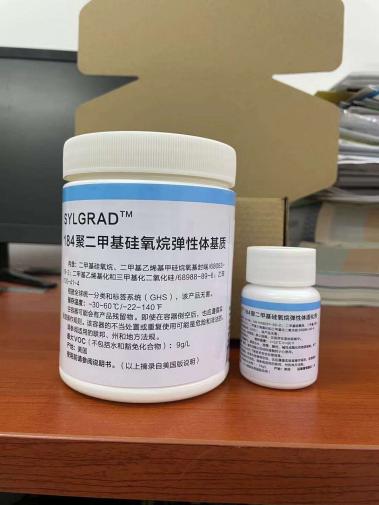
PDMS-微流控基质材料-PDMS/道康宁SYLGARD184-聚二甲基硅氧烷/0.5KG(组)

产品说明书PDF自助在线看:http://www.pdmshub.com/sih

信息更新:

美国总工厂生产的0.5KG原始包装的PDMS延期至2021年9月16日后才能交货,默认我们将发国内库存的进口分装产品(02085925-0.5KG);另受制于有机硅大幅涨价潮影响,2021年9月1日后将上调销售价格,另行通知。Dow Corning=道康宁=Dow SiL=陶氏,都是同一家公司。 2021.09.01更新

美国总工厂生产的0.5KG包装的PDMS恢复正常进口,合法正规,质量金标准,欢迎订购使用。并承诺从我司购买的皆为原厂包装,100%未开封,附带技术手册,非国产灌装仿制、非分装、非仿冒外包装产品,可以放心使用。大量订购更有优惠。2021.04.01更新

备注:由于dowsil与道康宁公司合并,美国总工厂生产的PDMS,价格涨幅高达1倍之多,因针对科研用户使用,特备货规格0.5KG。如果您需要美国总工厂原厂生产的大规格包装的预定,可以与QQ 11366508联系给予报价/货期。2021.05更新

此链接为PDMS-微流控芯片/PDMS/道康宁SYLGARD184/小桶0.5KG装的链接。

一般性的产品性能参数表参考以下小桶装的参数:

微流控芯片/PDMS/道康宁SYLGARD184;微流控芯片/PDMS/道康宁SYLGARD184;微流控芯片/PDMS/道康宁SYLGARD184;

品牌型号:道康宁SYLGARD184

包装规格:0.5KG/罐[含有45.4g固化剂,总重量为0.5KG]

产品颜色:保质期限:36个月

存放环境说明:室温,阴凉处保存

备注说明:

美国道康宁道康宁SYLGARD 184硅橡胶是由液体组分组成的双组分套件产品,包括基本组分与固化剂。基本组分与固化剂按10:1重量比完全混合,中等粘度混合液的稠度与SAE 40机油相似。无论厚薄,混合液将固化成为具有韧性的透明弹性体,最适用于电子/电气方面的封装与灌封应用。 道康宁SYLGARD 184硅橡胶在25~150℃的温度范围内固化,无放热现象,无需二次固化。固化过程完成后,可立即在-55~200℃的温度范围内使用。 产品特性:低毒性,在常规的工业操作中,无特别的注意事项; 无溶剂或固化副产物, 固化时不放热;无需特殊的通风条件,不会产生腐蚀;固化时,收缩量小; 固化后, 透明具有弹性;抗震与减缓机械震动;振动的传递性能小;元件可裸视检查与易修补性; 环保性能;低吸水性,良好的耐辐射性能;高真空状态下的低漏气性; 优异的电性能;较大温度范围内的稳定性, 抗解聚;在-55~200℃范围内,甚至在密闭状态下保持弹性与柔韧性,性能稳定; 阻燃性,UL可燃性分级为94 V-1,温度等级:130℃ 产品用途: 道康宁SYLGARD 184硅橡胶在电气/电子的封装与灌封方面有广泛的应用。