
一个工程化的心肌梗塞边界区芯片演示了氧梯度改变心肌细胞钙处理

ty10086 提交于 周三, 08/25/2021 - 16:21
文章英文标题
An Engineered Myocardial Infarct Border‐Zone‐on‐a‐Chip Demonstrates an Oxygen Gradient Alters Cardiomyocyte Calcium Handling
正文
引言\n在大多数心肌梗死( MI )患者中,一个粥样硬化斑块阻塞冠状动脉,从而阻碍血液和氧气( O2 )向心肌组织的流动。随着随后大量心肌细胞( CM )死亡,出现局部缺氧部位。由于心脏血供的扭曲,在受伤者、缺氧心肌组织与周围存活的、常氧心肌组织之间的MI边缘区发育陡峭的O2梯度。虽然边缘区被理解为CMs机电性质的一个过渡区,但关于O2梯度对人体心肌组织功能的影响知之甚少,包括低氧CMs对附近常氧CMs的影响,反之亦然。本研究的目的是设计一个O2景观微生理系统,使CMs暴露在模拟MI边界的O2梯度上,并研究其对CM钙瞬变和钙波传播速度( CPV )的影响。我们假设低氧CMs通过细胞接触和/或旁分泌机制改变O2梯度景观中相邻常氧CMs的钙处理。\n\n\n方法\n我们设计了一种带有气体灌注微通道的聚二甲基硅氧烷( PDMS )微电生理系统来维持空间O2梯度。将上复PDMS气体扩散膜微接触印有纤维连接蛋白线图案,在装置表面培养新生大鼠心室肌细胞( NRVMs )各向异性单层。利用荧光O2传感器对O2梯度剖面进行了验证。O2调制4 h后,用荧光钙指示剂Fluo-4测量1   Hz电起搏过程中的钙瞬变和CPV。\n\n\n结果\n钙瞬变分析显示,在O2梯度内,常氧NRVMs达到峰值的时间比相邻低氧NRVMs在梯度内( p \u003c 0.05 )、同质低氧NRVMs ( p \u003c 0.01 )和同质常氧NRVMs ( p \u003c 0.001 )均增加。与对照组相比,O2梯度的存在也增加了衰变的时间常数( p \u003c 0.01 )。CPV结果显示,与均一对照相比,O2梯度内常氧NRVMs的横向速度较慢( 5.3±3.9 vs . 13.4±3.2   cm / s,p = 0.02 )。\n\n\n结论\n总体而言,数据表明,在O2梯度中常氧暴露的CMs中存在钙瞬变的延迟激发和延迟恢复。此外,梯度中常氧CMs的横向CPV是由邻近的低氧CMs驱动的。我们的体外边界区O2景观使我们能够研究常氧和低氧CMs之间持续的相互作用,这对于更好地理解急性MI的影响,揭示MI后重塑的机制,以及创造新的治疗方法以减少心肌损伤和低氧性心脏损伤的扩大至关重要。
文章内容(英文)
Introduction\nDuring most cases of myocardial infarction (MI), an atherosclerotic plaque occludes a coronary artery, thereby obstructing the flow of blood and oxygen (O2) to the myocardial tissue. A localized site of hypoxia develops with subsequent massive cardiomyocyte (CM) cell death. As a result of the distorted cardiac blood supply, steep O2 gradients develop at the MI border zone region between the injured, hypoxic myocardial tissue and the surrounding viable, normoxic myocardial tissue. Although the border zone is understood to be a transition region in electromechanical properties of CMs, little is known about the effect of O2 gradients on the function of human myocardial tissue, including the effect of hypoxic CMs on nearby normoxic CMs and vice versa. The objective of this study was to engineer an O2 landscape microphysiological system to expose CMs to O2 gradients that mimic an MI border zone and study its effect on CM calcium transients and calcium wave propagation velocity (CPV). We hypothesize that hypoxic CMs alter the calcium handling in adjacent normoxic CMs across an O2 gradient landscape via cell‐cell contact and/or paracrine‐mediated mechanisms.\n\n\nMethods\nWe engineered a polydimethylsiloxane (PDMS) microphysiological system with buried, gas‐perfused microchannels to maintain a spatial O2 gradient. An overlying PDMS gas diffusion membrane was microcontact printed with a fibronectin line pattern to culture anisotropic monolayers of neonatal rat ventricular myocytes (NRVMs) on the device surface. The O2 gradient profile was validated using fluorescent O2 sensors. After 4 hours of O2 modulation, the fluorescent calcium indicator Fluo‐4 was used to measure calcium transients and CPV during 1 Hz electrical pacing.\n\n\nResults\nCalcium transient analysis showed an increase in the time to peak in normoxic NRVMs within the O2 gradient as compared to adjacent hypoxic NRVMs in the gradient (p \u003c 0.05) and homogenous hypoxic (p \u003c 0.01) and homogenous normoxic (p \u003c 0.001) control devices. The presence of the O2 gradient also increased the time constant of decay as compared to the controls (p \u003c 0.01). CPV results showed that transverse velocity was slower in normoxic NRVMs within the O2 gradient compared to the homogenous normoxic control (5.3 ± 3.9 vs. 13.4 ± 3.2 cm/s, p=0.02).\n\n\nConclusions\nOverall, the data demonstrate that there is a delayed excitation and delayed recovery of calcium transients in CMs exposed to normoxia in an O2 gradient. Additionally, the transverse CPV in normoxic CMs in the gradient is driven by the nearby hypoxic CMs. Our in vitro border zone O2 landscape allows us to investigate ongoing interactions between normoxic and hypoxic CMs, which is key to developing a better understanding of the effects of acute MI, uncovering the mechanisms of post‐MI remodeling, and creating novel therapies to minimize myocardial damage and the expansion of hypoxic cardiac injury.
来源出处
Journal|[J]The FASEB JournalVolume 35, 2021.
DOI
https://doi.org/10.1096/FASEBJ.2021.35.S1.02883

PDMS臻品推荐

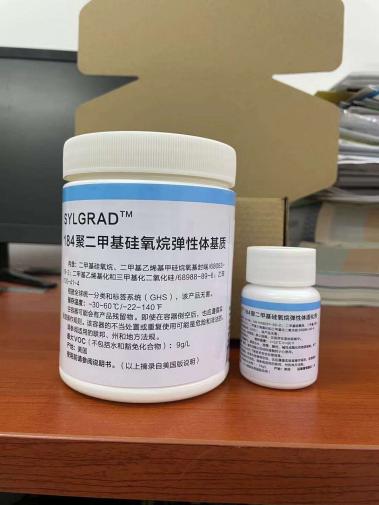
PDMS-微流控基质材料-PDMS/道康宁SYLGARD184-聚二甲基硅氧烷/0.5KG(组)

产品说明书PDF自助在线看:http://www.pdmshub.com/sih

信息更新:

美国总工厂生产的0.5KG原始包装的PDMS延期至2021年9月16日后才能交货,默认我们将发国内库存的进口分装产品(02085925-0.5KG);另受制于有机硅大幅涨价潮影响,2021年9月1日后将上调销售价格,另行通知。Dow Corning=道康宁=Dow SiL=陶氏,都是同一家公司。 2021.09.01更新

美国总工厂生产的0.5KG包装的PDMS恢复正常进口,合法正规,质量金标准,欢迎订购使用。并承诺从我司购买的皆为原厂包装,100%未开封,附带技术手册,非国产灌装仿制、非分装、非仿冒外包装产品,可以放心使用。大量订购更有优惠。2021.04.01更新

备注:由于dowsil与道康宁公司合并,美国总工厂生产的PDMS,价格涨幅高达1倍之多,因针对科研用户使用,特备货规格0.5KG。如果您需要美国总工厂原厂生产的大规格包装的预定,可以与QQ 11366508联系给予报价/货期。2021.05更新

此链接为PDMS-微流控芯片/PDMS/道康宁SYLGARD184/小桶0.5KG装的链接。

一般性的产品性能参数表参考以下小桶装的参数:

微流控芯片/PDMS/道康宁SYLGARD184;微流控芯片/PDMS/道康宁SYLGARD184;微流控芯片/PDMS/道康宁SYLGARD184;

品牌型号:道康宁SYLGARD184

包装规格:0.5KG/罐[含有45.4g固化剂,总重量为0.5KG]

产品颜色:保质期限:36个月

存放环境说明:室温,阴凉处保存

备注说明:

美国道康宁道康宁SYLGARD 184硅橡胶是由液体组分组成的双组分套件产品,包括基本组分与固化剂。基本组分与固化剂按10:1重量比完全混合,中等粘度混合液的稠度与SAE 40机油相似。无论厚薄,混合液将固化成为具有韧性的透明弹性体,最适用于电子/电气方面的封装与灌封应用。 道康宁SYLGARD 184硅橡胶在25~150℃的温度范围内固化,无放热现象,无需二次固化。固化过程完成后,可立即在-55~200℃的温度范围内使用。 产品特性:低毒性,在常规的工业操作中,无特别的注意事项; 无溶剂或固化副产物, 固化时不放热;无需特殊的通风条件,不会产生腐蚀;固化时,收缩量小; 固化后, 透明具有弹性;抗震与减缓机械震动;振动的传递性能小;元件可裸视检查与易修补性; 环保性能;低吸水性,良好的耐辐射性能;高真空状态下的低漏气性; 优异的电性能;较大温度范围内的稳定性, 抗解聚;在-55~200℃范围内,甚至在密闭状态下保持弹性与柔韧性,性能稳定; 阻燃性,UL可燃性分级为94 V-1,温度等级:130℃ 产品用途: 道康宁SYLGARD 184硅橡胶在电气/电子的封装与灌封方面有广泛的应用。