
微胶囊的芯片表征采用电容传感器进行微胶囊化和单细胞分析应用

ty10086 提交于 周三, 08/25/2021 - 15:46
文章英文标题
On-Chip Characterization of Microcapsules Using a Capacitive Sensor for Microencapsulation and Single-Cell Analysis Applications
正文
引言液滴微流控技术已成为生物医学应用的多功能工具。近年来,各种微流控液滴生成平台,如T型连接、流动聚焦、共流等,被广泛应用于细胞、药物和生物分子等微囊的高通量生成。微流控微胶囊是一种快速、可控的制备均匀微囊的方法,能够在微囊的制备过程中调节微囊的大小和理化性质[ 1,2 ]。在微流控液滴生成系统中,液滴的形成可以分为挤压、滴加和喷射三个阶段。生成液滴在稳定性和均匀性方面的质量可以受到流型的高度影响。由于液滴的流动状态和大小会受到系统变量的微小变化(如分散相和连续相的流速比)的影响,因此实时监测液滴的生成对于生物医学应用尤为重要[ 3,4 ]。为了应对上述挑战,本工作开发了微流控液滴生成装置( T结和流动聚焦),用于对益生菌进行良好的控制封装。为了对微胶囊进行表征,设计了一种电容传感器并集成到芯片中。最后,对所制备的用于封装过程片上监测的微流控器件的性能进行了评价。材料与方法该装置由集成在聚二甲基硅氧烷( PDMS )芯片中的金微电极制成。微流控芯片采用光刻和湿法刻蚀工艺刻划电极的玻璃基底,在洁净室设施中制备。然后,通过在模具上浇注PDMS,然后通过等离子处理机将PDMS通道与载玻片连接,制备出带有进出口的微流控通道。以含有藻酸盐和大肠杆菌DH5 - alpha ( E.coli DH5a )的分散相( DP )作为细菌模型,通过中心通道注入。连续相( CP )是矿物油和跨80的混合溶液通过另一个通道注入。为了表征所生成的微胶囊,当益生菌被包埋在芯片上时,使用恒电位仪记录电极间电容的变化。结果与结论利用微流控装置将大肠杆菌细胞包裹在水凝胶微囊内。聚合物微囊一旦被摄取,会在胃的酸性pH中保护益生菌,在pH升高到7以上的肠道中溶解或溶胀,释放被包埋的益生菌。所提出的微流控微囊化方法可用于含益生菌细胞微囊的高通量制备,作为新型药物输送系统。通过改变分散相和连续相的流速比,并测量微电极之间的电容,精确地调节了所制备微胶囊的大小和形状。结果表明,通过传感器信号可以确定微胶囊的大小、形状以及流型(图1 )。利用无创性和无标记的阻抗谱技术,可以根据介电性能的差异来识别单个微胶囊。微胶囊表征体系许可将是评价微胶囊化过程以及计算产生微胶囊数量的有力工具。此外,如果对方法进行优化,则有可能计算每个胶囊中单个细胞的数量。微流控器件中单分散液滴的产生具有广泛的生物医学应用,如药物封装。由于所开发的装置对单个液滴的精细控制,希望本研究能吸引显著的int
文章内容(英文)
Introduction Droplet microfluidics has emerged as a versatile tool for a wide range of biomedical applications. Recently, various types of microfluidic droplet-generation platforms such as T-junction, flow-focusing, and co-flow, have been used for high throughput generation of microcapsules containing cells, drugs and biomolecules. microfluidic microencapsulation is a fast and well-controlled method for the generation of uniform microcapsules with the capability of tuning the size and physicochemical properties of microcapsules during the encapsulation process [1,2].In a microfluidic droplet generation system, droplet formation can be widely classified into three regimes (squeezing, dripping, and jetting). The quality of the generated droplets in terms of stability and uniformity can be highly affected by the type of flow regimes. Since the flow regime and size of the droplets can be influenced by a small change in the system variables (such as the flow rate ratio of the dispersed and continuous phase), real-time monitoring of the droplet generation is vital especially for biomedical applications [3,4].To address the above challenges, in this work we developed microfluidic droplet generation devices (T-junction and flow-focusing) for a well-controlled encapsulation of probiotic bacteria. In order to characterize microcapsules, a capacitive sensor was designed and integrated into the chip. Finally, the performance of the fabricated microfluidic device for on-chip monitoring of the encapsulating process was evaluated. Materials and Methods The device is made out of gold microelectrodes integrated into a polydimethylsiloxane (PDMS) chip. The microfluidic chip was fabricated in a cleanroom facility using a glass substrate with electrodes patterned by photolithography and wet etching process. A microfluidic channel was then fabricated with inlets and outlets by pouring PDMS over a mold followed by bonding the PDMS channel to the glass slide via plasma treatment machine. The dispersion phase (DP) containing alginate and Escherichia coli DH5-alpha (E. coli DH5a), as a bacterial model, was injected through a central channel. The continuous phase (CP) was the mixture solution of mineral oil and span 80 that injected through the other channel. To characterize the generated microcapsules, the change in capacitance between the electrodes was recorded using a potentiostat as probiotic bacteria were encapsulated on the chip. Results and Conclusions E.coli cells were encapsulated inside of hydrogel microcapsules using the microfluidic device. The polymeric microcapsules, once ingested, will protect the probiotics in the acidic pH of the stomach and dissolve or swell in the intestine where the pH increases above 7 to release the entrapped probiotics. The proposed microfluidic microencapsulation method can be used for the high-throughput production of microencapsulates containing probiotic cells as new drug delivery systems.The size and shape of the generated microcapsules was precisely tuned by changing the flow rate ratio of the dispersed and continuous phases followed by measuring the capacitance between the microelectrodes. The results show that the size and shape of microcapsules, as well as the flow regime, can be determined by the sensors signal (Fig 1).Individual microcapsules can be identified based on differences in dielectric properties using impedance spectroscopy techniques which are non-invasive and label-free. The microcapsule characterization system permits will be a powerful tool for evaluating the microencapsulation process as well as calculating the number of produced microcapsules. Besides, there is a potential to calculate the number of single cells in each capsule if the method is optimized.Monodisperse droplet generation in microfluidic devices has wide biomedical applications such as drug encapsulation. Due to the fine control of individual droplets using the developed device, we hope this study attracts significant interest in food and pharmaceutical studies. Reference Zhu, Pingan, and Liqiu Wang. \"Passive and active droplet generation with microfluidics: a review.\" Lab on a Chip1 (2017): 34-75.Chong, Zhuang Zhi, et al. \"Active droplet generation in microfluidics.\" Lab on a Chip1 (2016): 35-58.Shang, Luoran, Yao Cheng, and Yuanjin Zhao. \"Emerging droplet microfluidics.\" Chemical reviews12 (2017): 7964-8040Shi, Zhi, et al. \"Step emulsification in microfluidic droplet generation: mechanisms and structures.\" Chemical Communications64 (2020): 9056-9066. Figure 1
来源出处
Journal|[J]Meeting AbstractsVolume MA2021-01, Issue 60. 2021.
DOI
https://doi.org/10.1149/MA2021-01601603MTGABS

PDMS臻品推荐

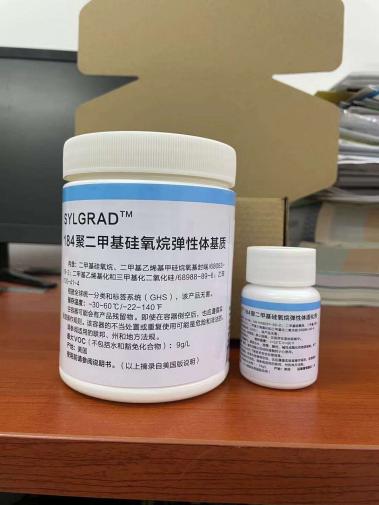
PDMS-微流控基质材料-PDMS/道康宁SYLGARD184-聚二甲基硅氧烷/0.5KG(组)

产品说明书PDF自助在线看:http://www.pdmshub.com/sih

信息更新:

美国总工厂生产的0.5KG原始包装的PDMS延期至2021年9月16日后才能交货,默认我们将发国内库存的进口分装产品(02085925-0.5KG);另受制于有机硅大幅涨价潮影响,2021年9月1日后将上调销售价格,另行通知。Dow Corning=道康宁=Dow SiL=陶氏,都是同一家公司。 2021.09.01更新

美国总工厂生产的0.5KG包装的PDMS恢复正常进口,合法正规,质量金标准,欢迎订购使用。并承诺从我司购买的皆为原厂包装,100%未开封,附带技术手册,非国产灌装仿制、非分装、非仿冒外包装产品,可以放心使用。大量订购更有优惠。2021.04.01更新

备注:由于dowsil与道康宁公司合并,美国总工厂生产的PDMS,价格涨幅高达1倍之多,因针对科研用户使用,特备货规格0.5KG。如果您需要美国总工厂原厂生产的大规格包装的预定,可以与QQ 11366508联系给予报价/货期。2021.05更新

此链接为PDMS-微流控芯片/PDMS/道康宁SYLGARD184/小桶0.5KG装的链接。

一般性的产品性能参数表参考以下小桶装的参数:

微流控芯片/PDMS/道康宁SYLGARD184;微流控芯片/PDMS/道康宁SYLGARD184;微流控芯片/PDMS/道康宁SYLGARD184;

品牌型号:道康宁SYLGARD184

包装规格:0.5KG/罐[含有45.4g固化剂,总重量为0.5KG]

产品颜色:保质期限:36个月

存放环境说明:室温,阴凉处保存

备注说明:

美国道康宁道康宁SYLGARD 184硅橡胶是由液体组分组成的双组分套件产品,包括基本组分与固化剂。基本组分与固化剂按10:1重量比完全混合,中等粘度混合液的稠度与SAE 40机油相似。无论厚薄,混合液将固化成为具有韧性的透明弹性体,最适用于电子/电气方面的封装与灌封应用。 道康宁SYLGARD 184硅橡胶在25~150℃的温度范围内固化,无放热现象,无需二次固化。固化过程完成后,可立即在-55~200℃的温度范围内使用。 产品特性:低毒性,在常规的工业操作中,无特别的注意事项; 无溶剂或固化副产物, 固化时不放热;无需特殊的通风条件,不会产生腐蚀;固化时,收缩量小; 固化后, 透明具有弹性;抗震与减缓机械震动;振动的传递性能小;元件可裸视检查与易修补性; 环保性能;低吸水性,良好的耐辐射性能;高真空状态下的低漏气性; 优异的电性能;较大温度范围内的稳定性, 抗解聚;在-55~200℃范围内,甚至在密闭状态下保持弹性与柔韧性,性能稳定; 阻燃性,UL可燃性分级为94 V-1,温度等级:130℃ 产品用途: 道康宁SYLGARD 184硅橡胶在电气/电子的封装与灌封方面有广泛的应用。