
用于疏水表面共形纳米涂层的醇基高导电聚合物对高灵敏、稳定的压力传感器

ty10086 提交于 周三, 08/25/2021 - 16:53
文章英文标题
Alcohol-based highly conductive polymer for conformal nanocoatings on hydrophobic surfaces toward a highly sensitive and stable pressure sensor
正文
摘要\n在疏水不均匀表面共形、超薄地涂复高导电PEDOT∶PSS对电阻式压力传感器应用至关重要。为此,采用超滤法,成功地将一种水基聚( 3,4 -乙撑二氧噻吩)聚苯乙烯磺酸盐( PEDOT:PSS )溶液交换到一种有机溶剂基PEDOT:PSS溶液中,不发生任何聚集或电导率降低。在各种溶剂中,乙醇( EtOH )溶剂交换的PEDOT:PSS溶液的接触角为34.67°,远低于水基PEDOT:PSS溶液的96.94°。优化后的EtOH基PEDOT:PSS溶液呈现共形均匀的涂层,在疏水的金字塔型聚二甲基硅氧烷( PDMS )表面得到超薄纳米涂层薄膜。所制备的压力传感器具有高灵敏度(在100 Pa的低压区为-21 k Pa-1 )、机械稳定性(超过1万次循环,没有任何失效或裂纹)和快速响应时间( 90 ms )等性能。最后,将本文提出的压力传感器成功演示为人体血脉率传感器和空间压力传感器阵列,用于实际应用。利用超滤进行这些应用的溶剂交换过程可以作为改善导电聚合物以及其他各种材料涂层性能(润湿性)的通用技术。\n传感器:一种灵活的连接方式\n韩国研究人员开发了一种在聚合物压力传感器上附加柔性导电触头的方法。柔性压力传感器可以集成到可穿戴电子和触觉机器人系统中。这些器件的一种可能材料是导电聚合物,它是稳定的、高度敏感的和对机械变化的快速响应。但是,由于它们是疏水性的,即它们排斥水,所以很难将必要的柔性电触头连接到它们上。由Cheonan韩国工业技术学院的Sunjong Lee和Suwon的Sungkyunkwan大学的Sunkook Kim领导的研究小组开发了一种超滤方法,使他们能够用柔性导电聚合物膜包复疏水性的基底。该小组利用该技术制造了一个敏感的压力传感器,经1万次以上循环测试,没有出现故障或开裂。\n采用超滤法成功地将PEDOT:PSS水溶液的水与乙二醇或乙醇溶剂交换。这种新颖的溶剂交换工艺使PEDOT∶PSS在疏水基底上均匀、共形纳米包复,无需添加表面活性剂。该工艺可广泛应用于利用导电聚合物制作各种传感器或电子器件。[图略:见全文]
文章内容(英文)
Abstract(#br)Conformal and ultrathin coating of highly conductive PEDOT:PSS on hydrophobic uneven surfaces is essential for resistive-based pressure sensor applications. For this purpose, a water-based poly(3,4-ethylenedioxythiophene) polystyrene sulfonate (PEDOT:PSS) solution was successfully exchanged to an organic solvent-based PEDOT:PSS solution without any aggregation or reduction in conductivity using the ultrafiltration method. Among various solvents, the ethanol (EtOH) solvent-exchanged PEDOT:PSS solution exhibited a contact angle of 34.67°, which is much lower than the value of 96.94° for the water-based PEDOT:PSS solution. The optimized EtOH-based PEDOT:PSS solution exhibited conformal and uniform coating, with ultrathin nanocoated films obtained on a hydrophobic pyramid polydimethylsiloxane (PDMS) surface. The fabricated pressure sensor showed high performances, such as high sensitivity (−21 kPa\u003csup\u003e−1\u003c/sup\u003e in the low pressure regime up to 100 Pa), mechanical stability (over 10,000 cycles without any failure or cracks) and a fast response time (90 ms). Finally, the proposed pressure sensor was successfully demonstrated as a human blood pulse rate sensor and a spatial pressure sensor array for practical applications. The solvent exchange process using ultrafiltration for these applications can be utilized as a universal technique for improving the coating property (wettability) of conducting polymers as well as various other materials.(#br)Sensors: a flexible way to connect(#br)A method for attaching flexible conducting contacts to polymer pressure sensors has been developed by researchers in South Korea. Flexible pressure sensors can be integrated into wearable electronics and tactile robotic systems. One possible material for these devices is a conducting polymer, which is stable, highly sensitive and quickly responds to mechanical changes. However, it is difficult to connect the necessary flexible electrical contacts to them because they are hydrophobic, i.e., they repel water. A team led by Sunjong Lee, Korea Institute of Industrial Technology, Cheonan, and Sunkook Kim, Sungkyunkwan University, Suwon, have developed an ultrafiltration method that enabled them to coat a hydrophobic substrate with a flexible conducting polymer film. The team used the technique to create a sensitive pressure sensor which was tested over 10,000 cycles without failure or cracking.(#br)Water of aqueous PEDOT:PSS solution was successfully exchanged with ethylene glycol or ethanol solvents using ultrafiltration method. This novel solvent exchange process enables uniform and conformal nano-coating of PEDOT:PSS on hydrophobic substrates without the addition of surfactants. This process can be widely used in fabrication of various sensors or electronic devices using conducting polymers. [graphic not available: see fulltext]
来源出处
Journal|[J]NPG Asia MaterialsVolume 12, Issue 1. 2020. PP 9966-9970
DOI
https://doi.org/10.1038/s41427-020-00238-z

PDMS臻品推荐

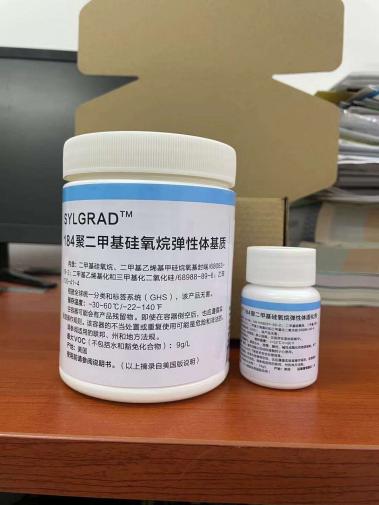
PDMS-微流控基质材料-PDMS/道康宁SYLGARD184-聚二甲基硅氧烷/0.5KG(组)

产品说明书PDF自助在线看:http://www.pdmshub.com/sih

信息更新:

美国总工厂生产的0.5KG原始包装的PDMS延期至2021年9月16日后才能交货,默认我们将发国内库存的进口分装产品(02085925-0.5KG);另受制于有机硅大幅涨价潮影响,2021年9月1日后将上调销售价格,另行通知。Dow Corning=道康宁=Dow SiL=陶氏,都是同一家公司。 2021.09.01更新

美国总工厂生产的0.5KG包装的PDMS恢复正常进口,合法正规,质量金标准,欢迎订购使用。并承诺从我司购买的皆为原厂包装,100%未开封,附带技术手册,非国产灌装仿制、非分装、非仿冒外包装产品,可以放心使用。大量订购更有优惠。2021.04.01更新

备注:由于dowsil与道康宁公司合并,美国总工厂生产的PDMS,价格涨幅高达1倍之多,因针对科研用户使用,特备货规格0.5KG。如果您需要美国总工厂原厂生产的大规格包装的预定,可以与QQ 11366508联系给予报价/货期。2021.05更新

此链接为PDMS-微流控芯片/PDMS/道康宁SYLGARD184/小桶0.5KG装的链接。

一般性的产品性能参数表参考以下小桶装的参数:

微流控芯片/PDMS/道康宁SYLGARD184;微流控芯片/PDMS/道康宁SYLGARD184;微流控芯片/PDMS/道康宁SYLGARD184;

品牌型号:道康宁SYLGARD184

包装规格:0.5KG/罐[含有45.4g固化剂,总重量为0.5KG]

产品颜色:保质期限:36个月

存放环境说明:室温,阴凉处保存

备注说明:

美国道康宁道康宁SYLGARD 184硅橡胶是由液体组分组成的双组分套件产品,包括基本组分与固化剂。基本组分与固化剂按10:1重量比完全混合,中等粘度混合液的稠度与SAE 40机油相似。无论厚薄,混合液将固化成为具有韧性的透明弹性体,最适用于电子/电气方面的封装与灌封应用。 道康宁SYLGARD 184硅橡胶在25~150℃的温度范围内固化,无放热现象,无需二次固化。固化过程完成后,可立即在-55~200℃的温度范围内使用。 产品特性:低毒性,在常规的工业操作中,无特别的注意事项; 无溶剂或固化副产物, 固化时不放热;无需特殊的通风条件,不会产生腐蚀;固化时,收缩量小; 固化后, 透明具有弹性;抗震与减缓机械震动;振动的传递性能小;元件可裸视检查与易修补性; 环保性能;低吸水性,良好的耐辐射性能;高真空状态下的低漏气性; 优异的电性能;较大温度范围内的稳定性, 抗解聚;在-55~200℃范围内,甚至在密闭状态下保持弹性与柔韧性,性能稳定; 阻燃性,UL可燃性分级为94 V-1,温度等级:130℃ 产品用途: 道康宁SYLGARD 184硅橡胶在电气/电子的封装与灌封方面有广泛的应用。